



The short answer is that it depends entirely on your situation, and the longer answer is worth understanding before your next PCS because the difference between getting this right and getting it wrong can mean hundreds of dollars a month in unnecessary out-of-pocket expenses.
If you are junior enlisted and single, your housing is genuinely free. You live in the barracks, you pay nothing, and you receive no BAH. For everyone else, military housing works more like a heavily subsidized benefit than a free service. The government covers most of the cost through your Basic Allowance for Housing, but most is not all, and understanding where the gaps are gives you real leverage in your housing decision.
When Military Housing Is Actually Free and When It Is Not
Barracks housing is the only situation that truly qualifies as free in the way most people mean that word. Junior enlisted members, generally E-1 through E-4 depending on the branch, who are single or living without dependents are typically required to live on base at no charge. No rent, no utility bills, and no BAH paid out to them either. Their housing cost is zero.
Every other active duty situation involves BAH in some form. On-base family housing means your BAH goes directly to the housing office or privatized housing company instead of landing in your bank account. You do not see a rent bill, but you also do not see that money as cash. Off-base housing means BAH hits your account as tax-free income and you pay your landlord or mortgage from it. The distinction between these two models changes how your monthly budget actually works, even though neither one leaves you paying full market rate out of pocket.
| The 95% rule you need to know
According to the Department of Defense, BAH is designed to cover approximately 95% of median housing costs in each duty station market. That 5% gap is intentional, a cost-sharing policy phased in between 2015 and 2019. For most families it is manageable, but in high-cost markets like San Diego, Hawaii, or the Washington DC area, that gap can translate to real money every month. |
Your Five Actual Housing Options and What Each One Costs Your Family
You have more options than most families realize, and each one comes with a different cost structure. Here is what each one actually looks like in practice.
Living in the Barracks as a Single Service Member
Barracks living costs nothing in rent and nothing in utilities for members assigned there. The trade-off is privacy, space, mandatory inspections, and no control over who your neighbors are. There is also no BAH flowing to you, which means your total compensation looks smaller on paper than that of a colleague who lives off base and pockets their BAH surplus. For junior enlisted members focused on saving aggressively in the early years, barracks living can actually accelerate financial goals faster than any other option because every dollar of basic pay is available for savings or debt payoff.
Government-Owned On-Base Family Housing
Government-owned family housing is maintained directly by the Department of Defense and covers your rent and most standard utilities through your BAH, which you never see as cash.
The real cost here is your full BAH, which goes to the housing office rather than your bank. Quality varies significantly across installations. Some installations have newer housing stock that compares well with anything in the local rental market. Others have aging inventory with maintenance backlogs that frustrate families for months. Waitlists at popular duty stations can stretch from several weeks to well over six months, which creates its own set of problems at PCS time.
Privatized On-Base Housing Through Mhpi
The Military Housing Privatization Initiative transferred a significant portion of on-base family housing to private companies including Lincoln Military Housing, Balfour Beatty, and Corvias, among others. These companies build and manage the housing under long-term contracts with DoD, and your BAH goes directly to them as rent.
| What the investigations found
Congressional investigations beginning in 2019 documented widespread complaints about mold, pest infestations, and delayed repairs across MHPI properties. The Senate Armed Services Committee released findings confirming systemic issues at multiple installations managed by private housing companies. Knowing which company manages housing at your next duty station and reading recent resident reviews before you commit are worth the research time. |
Renting off Base Using Your Bah
Off-base renting gives you the most flexibility in terms of neighborhood, school district, commute, and home style. Your BAH arrives as tax-free income and you pay your landlord separately. If your total housing costs come in under your BAH rate, you keep the difference. If they exceed it, the shortfall comes out of your other income.
That flexibility also means your family is responsible for the practical rental details that come with living off base, including deposits, utilities, lease requirements, and personal property protection. As you compare rentals near your next duty station, you can review renters insurance from Lemonade alongside your BAH, move-in costs, and PCS housing budget.
One protection that matters enormously here is the military clause under the Servicemembers Civil Relief Act. This federal law allows you to terminate a lease early without financial penalty when you receive PCS orders or deploy for 90 or more days. You provide written notice along with a copy of your orders, and your obligation ends 30 days after the next rent due date. According to the Consumer Financial Protection Bureau’s guidance on SCRA protections, landlords are legally required to honor this and cannot charge early termination fees in qualifying situations.
Buying off Base Using Bah Toward Your Mortgage
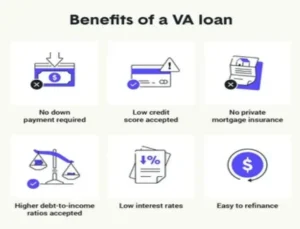
Active duty members can use BAH as qualifying income for a mortgage, and lenders often gross it up by 15% to 25% in their calculations because it is tax-free. Combined with VA loan benefits including no down payment requirement and no private mortgage insurance, this makes homeownership genuinely accessible for many military families.
The honest complexity is what happens at PCS time. If you buy and get orders 18 months later, you are either selling in whatever market conditions exist at that moment or becoming a long-distance landlord. Members who stay at a duty station for three or more years, or who have reason to expect they will return, tend to benefit most from buying. Members with shorter expected tours are usually better served by renting.
| BAH is tax-free income that lenders can gross up by 15 to 25 percent when calculating your mortgage qualification. Combined with the VA loan benefit, this gives military families a homebuying advantage most civilians simply do not have access to. |
What Bah Actually Covers and Where the Gaps Appear
BAH rates are set annually by the Department of Defense using rental market surveys conducted in each duty station area. Three factors determine your specific rate: your duty station ZIP code, your pay grade, and whether you have dependents. A member with dependents always receives a higher rate than a member without dependents at the same rank and location.
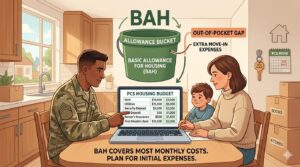
BAH can cover most housing costs, but families should still budget for deposits, insurance, utilities, and other PCS move-in expenses.
The 95% coverage policy means that someone renting at the median price for their market should expect to cover roughly 5% of housing costs from other income. The DoD’s BAH program information page at militarypay.defense.gov allows you to look up your specific rate for any duty station and dependency status combination before you commit to anything.
| The costs BAH does not cover that surprise families most at PCS time
✓ Security deposits at lease signing, typically one to two months of rent in competitive markets ✓ Utility deposits for electric, gas, water, and internet when you have no local payment history ✓ Pet deposits and monthly pet rent if your family includes animals ✓ Renters insurance, which is recommended for all renters and required by most lenders ✓ First and last month’s rent at lease signing in some markets |
What PCs Timing Does to Your Housing Options and Budget
On-base family housing operates with finite inventory. At high-demand installations, waitlists can run six months or longer. You report to your new duty station, you are not eligible to move into on-base housing yet, and you need somewhere to live in the meantime. Temporary lodging on base through a Temporary Lodging Facility is available at some installations but not all, and availability is not guaranteed.
Temporary Lodging Allowance helps offset the cost of off-base temporary lodging but typically does not cover the full expense of an extended stay in an unfamiliar market. The practical result is that many families end up in off-base rentals they did not originally intend to choose, signed quickly under time pressure, in neighborhoods they had no time to research properly. Connecting with a military housing concierge service before your orders are finalized, rather than after you arrive, changes what options are realistically available to you.
| Rental markets near military installations often move faster than BAH adjustments. BAH rates are set annually based on prior-year data, which means a rapid rent increase in your market may not be reflected in your allowance until the following calendar year. |
How to Think Through the Decision for Your Specific Situation
There is no universally right answer to the on-base versus off-base question. If your expected tour is short, meaning under two years, renting off base with the military clause as a safety net tends to be the most flexible and low-risk option. If your tour is longer, or if you have strong reason to believe you will return to the same location, buying with your VA loan benefit starts to make more financial sense.
On-base housing makes the most sense when your priority is eliminating housing management from your life entirely, when your budget requires the certainty of fixed housing costs, or when community and proximity to base resources matter more than neighborhood choice. Your BAH rate at your next duty station is the foundational number for this calculation. Looking it up at militarypay.defense.gov before you start researching neighborhoods, rental prices, or mortgage payments keeps the math grounded in reality.
The Questions Military Families Actually Ask About This
Every answer below is written to stand on its own so you can find what you need without reading the whole article from the start.
| Question | Answer |
| If I live in barracks, do I get any housing allowance at all? | No. Members assigned to barracks do not receive BAH. The trade-off is that you pay nothing for rent or utilities either. Your basic pay and other applicable allowances are fully available, but housing is handled in-kind rather than through a cash allowance. |
| Does BAH go up if my rent is higher than the standard rate? | BAH does not adjust automatically based on what you personally pay. Your rate is determined by your pay grade, dependency status, and duty station ZIP code and it is the same for all members in your category regardless of individual housing costs. If your rent exceeds your BAH, you cover the difference from other income. |
| What happens to my BAH during deployment? | If you maintain a home for dependents while deployed, you continue receiving BAH at the with-dependents rate for your permanent duty station. The Defense Finance and Accounting Service at dfas.mil provides specific guidance on BAH entitlements during deployment by individual situation. |
| Is on-base housing always better for families with kids? | Not automatically. On-base housing puts you close to base schools, childcare, and family support programs. Off-base housing gives you access to a wider range of school districts. The right answer depends on school quality in your specific area, your priorities around community versus independence, and practical factors like your spouse’s employment situation. |
| What if on-base housing at my next duty station has serious maintenance issues? | Document everything in writing from move-in day and photograph the property before you unpack. Report maintenance requests through the official channel and keep records of every submission. The Military Housing Complaint Resolution Program established through the 2020 NDAA provides a formal process for escalating unresolved concerns through your installation’s housing office. |
| Can my spouse receive BAH if I am deployed and she is living with family? | Generally a member with dependents continues receiving BAH during deployment to cover housing costs for the family. The specific rate depends on where dependents are residing and the member’s permanent duty station. Confirm the details with your finance office before orders execute because individual circumstances vary. |
| BAH, the VA loan benefit, and the military clause under SCRA give active duty families tools that most civilian renters and buyers simply do not have access to. Getting the most from them requires knowing what they cover and where the gaps are before you need to act on them. |
Making the Right Call for Your Family
Military housing is genuinely one of the better compensation elements available to service members when you understand how it works. Getting the most out of those tools requires knowing what they cover, what they do not, and how your specific situation fits into the options available at your next duty station.
If you want to talk through your specific housing situation before you make any commitments, MilHousing Network is exactly the resource for that conversation. We work with military families through every stage of the PCS process and we understand both the financial side and the practical reality of making housing decisions under time pressure. Reaching out is free, there is no obligation attached, and we are genuinely here to help your family land well wherever the orders send you next.
| Talk to someone who already knows your next duty station
MilHousing Network connects military families with local housing knowledge, vetted professionals, and real guidance before the pressure of a PCS deadline kicks in. Free for military families, always. |